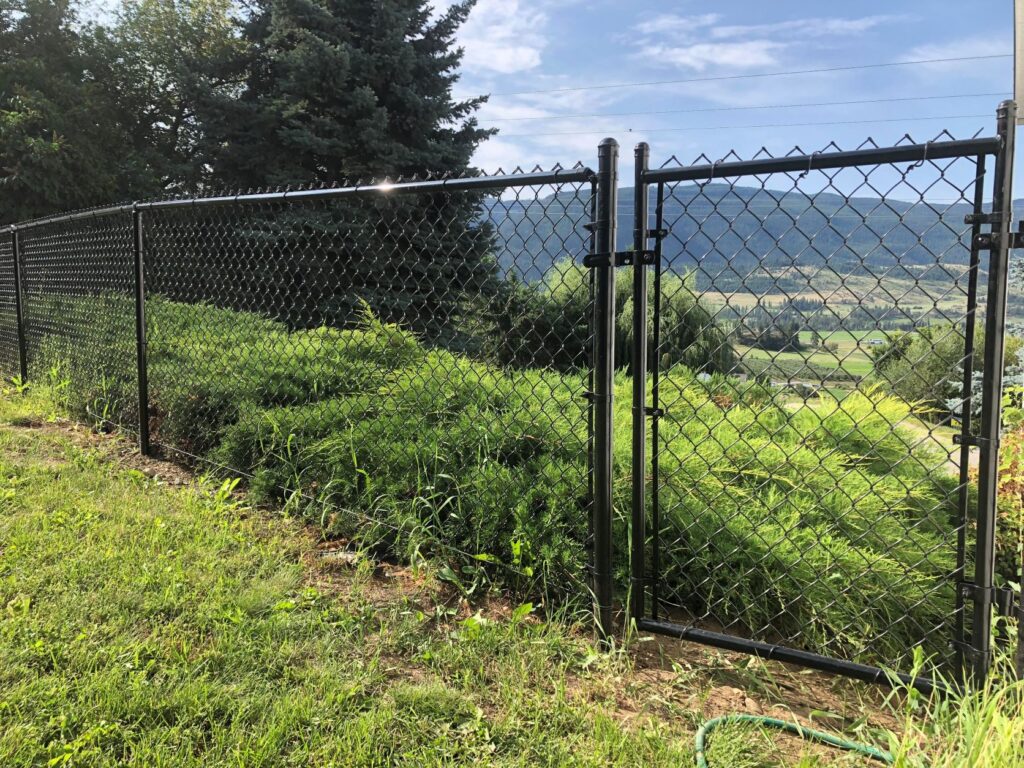
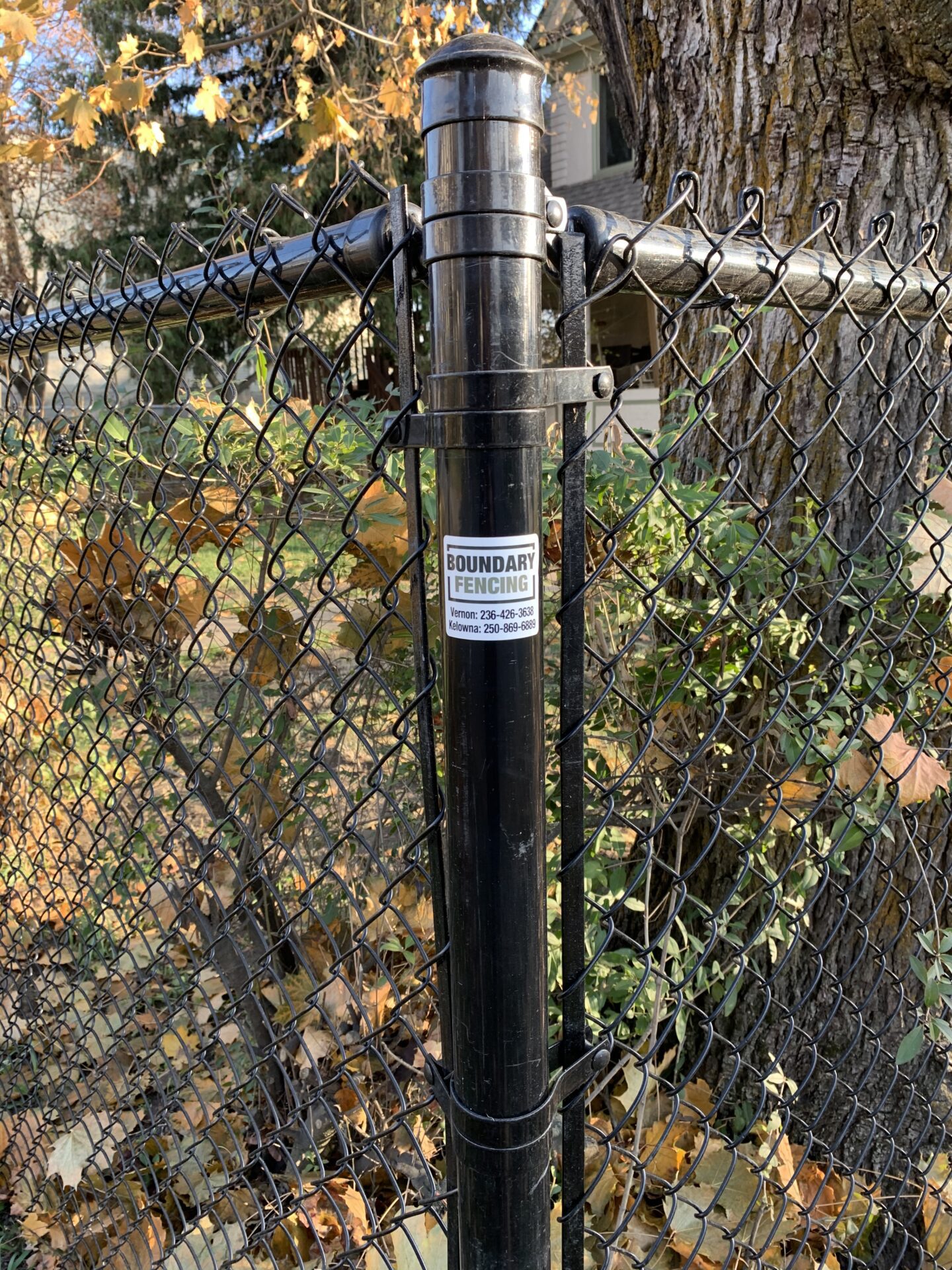
On a finished chain link fence, the top rail runs through a line post top on every line post. The gate posts are terminal posts, where the mesh is tensioned with tension bars and tension bands.
By Lee Munsey, Owner at Boundary Fencing | October 2026
If you’ve ever tried to purchase replacement parts for a chain link fence, you’ve probably discovered that identifying the correct fittings isn’t always straightforward. Chain link fences use a variety of specialized components, and knowing the difference between a line post top, rail end, tension band, and brace band can make ordering materials much easier.
At Boundary Fencing, we’ve been installing and supplying chain link fencing throughout the Okanagan and Shuswap since 2003. One of the most common challenges we encounter at our retail store is customers trying to identify a particular fitting without knowing its name.
In this guide, we’ll explain some of the most commonly confused chain link fence parts, what they do, and what to look for when purchasing quality fittings.
Understanding the Different Chain Link Fence Parts
Although chain link fencing is relatively straightforward, each component serves a specific purpose. Some fittings support the fence framework, while others are used to attach and tension the chain link mesh. Knowing which fitting you need is particularly important when repairing an existing fence or purchasing DIY chain link fence materials.
-
Line Post Tops (Eye Tops)
Browse Line Post Tops/ Eye Tops
Line post tops, sometimes called eye tops, are the fittings installed on top of the intermediate posts along a chain link fence. These intermediate posts, commonly called line posts, are positioned between the terminal posts.
The line post top serves two purposes:
It caps the top of the line post.
It allows the top rail to pass through the fitting.
The opening in the line post top supports the top rail while allowing it to run continuously along the fence. When purchasing replacement line post tops, it’s important to select the correct size for both the line post and the top rail.
-
Rail Ends
Browse Rail Ends
A rail end is the fitting installed at the end of the top rail where the rail terminates at a terminal post. Terminal posts include end posts, corner posts, and gate posts.
Unlike a line post top, which allows the rail to pass through, a rail end provides the connection point at the end of the rail. The rail end fits onto the end of the top rail, while a brace band secures the rail end to the terminal post, typically using a carriage bolt.
Customers frequently recognize this fitting but don’t know what it’s called. If you’re looking for the fitting that fits onto the end of your top rail, you’re looking for a rail end. You’ll also need a brace band to attach it to the terminal post.
-
Brace Bands
Browse Brace Bands
Brace bands are commonly confused with tension bands because they look similar, but they perform different functions. A brace band is used to attach a rail end to a terminal post.
Unlike tension bands, which have an offset shape and longer fastening tabs, brace bands are centred on the post and have shorter tabs. These differences make the two fittings easier to identify side by side.
-
Tension Bands
Browse Tension Bands
Tension bands are used to attach the tension bar to a terminal post. The tension bar passes vertically through the end of the chain link mesh. Tension bands connect that bar to the terminal post so the mesh can be properly tensioned during installation.
One distinguishing feature of a tension band is its offset shape and longer fastening tabs, which help differentiate it from a brace band. The offset allows the tension bar to sit in the correct position relative to the terminal post.
As a general rule of thumb, use one fewer tension band per termination than the fence height in feet. For example, a four-foot-high fence typically uses three tension bands per termination, and a five-foot-high fence uses four.
The easiest way to remember the difference:
- Tension band: Attaches the tension bar to the terminal post.
- Brace band: Attaches the rail end to the terminal post.
-
Tension Bars
Browse Tension Bars
A tension bar is a long, flat steel bar inserted vertically through the end of the chain link mesh. It provides a connection point for attaching the mesh to a terminal post using tension bands.
Tension bars are essential for properly tensioning the fence fabric and securing it at the ends of fence sections. Although most customers are familiar with tension bars, understanding how they work with tension bands is important when purchasing replacement materials.
One common mistake made by DIY installers is running the chain link mesh continuously past terminal posts, particularly at corners where the change in direction is relatively small. Although it may seem easier to continue the mesh around the corner, the proper installation method is to terminate and tension the mesh separately at each terminal post, using tension bars and tension bands.
-
Dome Caps
Browse Dome Caps
Dome caps are installed on top of terminal posts to cover the top of the post. Unlike line post tops, dome caps don’t have an opening for the top rail.
At Boundary Fencing, dome caps are one of the few chain link fittings where we prefer aluminum over pressed steel. The reason is primarily installation.
Pressed-steel dome caps often fit extremely tightly over the post. When tapping them into place, they can become slightly crooked and difficult to straighten. Sometimes, installing a pressed-steel dome cap requires making relief cuts in the top of the post to allow the cap to seat properly.
Aluminum dome caps are considerably easier to install straight and square. Because dome caps aren’t subjected to significant wear or mechanical stress, the difference in durability between aluminum and steel isn’t particularly important for this application.
Does the Quality of Chain Link Fence Fittings Matter?
Absolutely. One of the biggest differences between chain link fence materials is the quality of the fittings. Although two fittings may look almost identical, differences in material composition and thickness can affect their strength and durability.
Thin, Lightweight Steel Fittings
Some steel fittings sold through big-box retailers are manufactured using very thin steel. Although these fittings may be inexpensive, they can be flimsy compared with heavier, professional-grade pressed-steel fittings. Steel thickness is an important consideration when selecting fittings intended to provide a durable connection.
Aluminum Versus Pressed-Steel Fittings
Aluminum fittings are another option commonly available for chain link fencing. While aluminum fittings are generally thicker than their pressed-steel counterparts, thickness alone doesn’t determine durability.
In our experience, aluminum fittings don’t stand up as well as quality pressed-steel fittings in applications where strength and durability are important. For this reason, Boundary Fencing generally prefers quality pressed-steel fittings for structural connections, reserving aluminum primarily for dome caps.
The important distinction is that not all steel fittings are created equal. A thin, inexpensive steel fitting shouldn’t be confused with a heavier, professional-grade pressed-steel fitting.
Choosing the Correct Replacement Parts
If you’re repairing an existing chain link fence, identifying the correct fitting is only the first step. You’ll also need to make sure the replacement part is compatible with your existing fence.
Before purchasing materials, consider the following:
- Post diameter: Fittings must match the outside diameter of the fence posts.
- Rail diameter: Line post tops and rail ends must accommodate the correct top rail size.
- Finish: Choose fittings that are compatible with your galvanized or coloured chain link fence.
- Material quality: Consider the thickness and durability of the fitting, not just its price.
If you’re unsure which fitting you need, bringing the existing part into our retail store is often the easiest solution. We can identify the fitting and help you find the correct replacement.
Why Professional-Grade Chain Link Parts Are Worth Considering
A chain link fence is only as reliable as the materials and workmanship used to build it. While much of the attention naturally goes toward the posts, rails, and mesh, the smaller fittings play an important role in holding the fence together.
Choosing quality fittings helps ensure the connections perform as intended throughout the life of the fence. For homeowners purchasing materials for a DIY project, using the correct components from the beginning can also make installation easier and reduce the likelihood of future repairs.
Need Help Finding Chain Link Fence Parts?
Whether you’re repairing a damaged fence, replacing missing fittings, or building a new chain link fence, Boundary Fencing can help you identify and purchase the correct materials.
We’ve been supplying and installing chain link fencing throughout the Okanagan and Shuswap since 2003. Visit our retail store in Vernon to see the different fittings in person and get advice on selecting the right components for your project.
Contact Boundary Fencing today for chain link fence parts, materials, and professional installation services.
About Boundary Fencing
Boundary Fencing is a local, family-run fence and gate company serving the North and Central Okanagan and the Shuswap since 2003. From Vernon and Kelowna, our certified installers build agricultural, residential, commercial, and specialized wildlife exclusion fencing, with every project managed from start to finish by our in-house team. Crews arrive fully briefed, work to WorkSafeBC standards, and leave the site clean. Each month, a portion of our work supports a charity chosen by our clients. Get a quote or visit our showroom.