
By the Boundary Fencing team | August 2026
Automatic driveway gates are becoming increasingly common on acreages, estate properties, and residential properties throughout the Okanagan. They provide security and convenience, but there is a significant difference between simply putting an operator on a gate and installing a complete gate system properly.
At Boundary Fencing, we’ve been building fences and gates throughout the Okanagan since 2003. Automatic gates are one area where we see homeowners underestimate both the cost and the amount of equipment required to build a safe, reliable system.
As Lee from Boundary Fencing explains, one of the biggest surprises is usually the price.
“Most people don’t expect an automatic gate system to cost what it does. A double swing gate operator installation, for example, can easily be in the $12,000 to $15,000 range.”
That doesn’t mean every automatic gate operator costs $15,000. Gate design, driveway width, electrical requirements, access controls, safety equipment, and site conditions all affect the final price.
What matters is understanding what you’re actually getting for that investment.
Why Are Automatic Gate Systems More Expensive Than People Expect?
A homeowner researching gate operators online can find relatively inexpensive equipment. That can create an unrealistic expectation of what a professionally installed automatic gate should cost.
The operator itself is only one component.
A complete installation may require the gate, operator or operators, electrical work, control equipment, vehicle detection loops, photo eyes, edge sensors, access controls, underground wiring, concrete work, and other components specific to the property.
Boundary Fencing generally works with higher-end LiftMaster equipment rather than designing a system around the lowest-cost operator available.
For us, two considerations are particularly important: serviceability and safety.
When something eventually needs attention, we want to be dealing with equipment that can be serviced and supported. And from the beginning, the gate needs to be designed as a complete automated system—not simply a gate with a motor attached to it.
Safety Equipment Isn’t What Makes the Gate Work
This is an important distinction.
An automatic gate can physically open and close without all of the additional safety equipment.
That doesn’t mean it should.
As Lee puts it:
“You don’t need those devices to make the gate function. The gate will function without them. But if you want a safe gate that isn’t going to be a hazard to people, equipment or vehicles, you can’t build it without them.”
Some of the important safety components we consider include:
- Photo eyes, which detect people or objects within designated areas of the gate’s travel.
- Edge sensors, which detect contact with an obstruction.
- Ground loops, which can detect vehicles and help prevent the gate from closing onto a vehicle.
- Fall-over protection, particularly where the gate design creates a potential hazard if a component fails.
These aren’t accessories we add simply to make a gate system more sophisticated. They are part of designing an automated gate that can operate around people and vehicles safely.
Swing Gate or Cantilever Gate?
One of the first design decisions is whether the property is better suited to a swing gate or a sliding cantilever gate.
Swing Gates
Swing gates can work very well where there is sufficient room inside the property for the gate leaf—or leaves—to swing clear of vehicles.
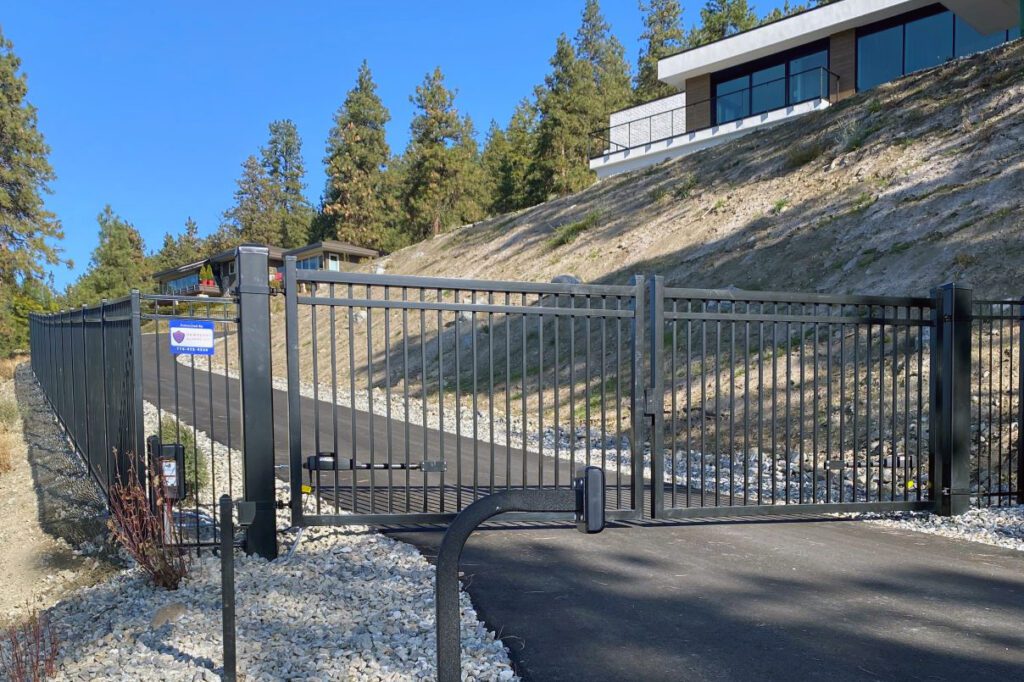
A single swing gate uses one gate leaf, while a double swing gate divides the driveway opening between two leaves.
Double swing gates require operators on both sides, which means electrical and control wiring generally needs to get from one side of the driveway to the other.
That additional infrastructure is one reason a double swing system becomes considerably more expensive than someone might initially expect. Particularly if the driveway is already paved or has a concrete slab.
Cantilever Gates
A cantilever gate slides horizontally alongside the fence instead of swinging into the property.
That makes it particularly useful where the driveway doesn’t have enough usable space for the arc of a swing gate.
There is another advantage that isn’t immediately obvious: security.
With many cantilever gate operators, manually opening the gate requires access to the operator’s control box. The operator then needs to be deliberately disengaged or placed into a neutral/manual mode before the gate can simply be pushed open.
Swing gates can be more vulnerable to manual defeat depending on how the system is constructed.
Often, swing gates have a magnetic lock holding them in the closed position. Unfortunately, the wiring associated with that lock can be disabled. Depending on the operator, some swing gate arms can also be disconnected, allowing the gate leaf to be pushed open manually.
That doesn’t make a swing gate insecure. It means security needs to be considered as part of the gate design rather than assuming every automated gate provides the same level of protection.
The First Question: Do We Have Power?
Before getting too far into gate styles and access controls, one of the first things we look at during a site visit is much more basic:
Where is the power coming from?
Automatic gates need a reliable power source, and on a large acreage or estate property, the gate can be a considerable distance from the house or other electrical services.
The location and availability of power can therefore have a significant effect on the design and installation cost.
For double swing gates, we also have to consider how we’re getting power and communication between the two sides of the driveway.
Solar-powered operators are an option, but the system needs to be designed for the amount of sunlight at the gate location. These systems often don’ t function correctly in the winter and may require you to have a spare battery on hand that you swap out regularly.
These aren’t details that should be figured out after the gate has already been ordered.
Driveway Width Determines More Than Gate Size
The second major consideration is the driveway itself.
We need to know how wide the opening needs to be and what kinds of vehicles will regularly use it.
A residential driveway serving passenger vehicles has very different requirements from an acreage that regularly sees trucks, trailers, equipment, delivery vehicles, RVs, or horse trailers.
The opening needs to work for how the property is actually used.
It also affects the physical gate design, operator selection, and whether a single swing, double swing, or cantilever arrangement makes the most sense.
Access Control and Gate Operators Are Two Different Things
This distinction is often misunderstood.
The gate operator physically opens and closes the gate.
The access-control system determines who is allowed to tell it to open.
For people entering the property, that might include a keypad, intercom, video intercom, remote control, or another access-control device.
Leaving the property can be handled differently. A vehicle-detection system can automatically recognize a vehicle approaching from inside the property and open the gate without the driver having to enter a code or use a remote.
A well-designed system considers both directions:
How do authorized people get in, and how do people conveniently get out?
What Goes Wrong With Automatic Gates?
If a gate and operator system is set up correctly, there should not be a lot of maintenance required.
The service calls can be considerably more mundane.
Dead batteries in remotes or other wireless devices, for example, can cause what initially appears to be a problem with the gate operator. We recommend changing batteries on devices that require them annually.
That’s one reason we put so much emphasis on installing quality, serviceable equipment correctly in the first place.
An automatic gate contains mechanical, electrical, safety, and access-control systems that all need to work together. The objective isn’t to install a system that requires constant attention. It’s to build one that operates reliably enough that the homeowner doesn’t have to think about it every day.
What Does an Automatic Driveway Gate Cost in the Okanagan?
There isn’t one useful number that applies to every property.
As a practical reference, though, a double swing automated gate installation can commonly be in the $12,000 to $15,000 range, depending on the gate, operators, controls, electrical requirements, safety equipment, and site conditions.
More complex installations can go considerably beyond that.
The important thing when comparing quotations is understanding exactly what is included.
Two quotes for an “automatic gate” aren’t necessarily quotations for equivalent systems.
One may include a properly designed gate, quality operators, vehicle detection, required safety devices, access controls and the infrastructure necessary to make everything work together.
Another may essentially be a gate and an opener.
Those aren’t the same product.
A Gate Operator Should Be Designed as a System
Automatic gates are one of those projects where the components you don’t immediately notice are often just as important as the gate itself.
The operator matters.
The electrical installation matters.
The safety devices matter.
The gate construction matters.
The access-control system matters.
And the way all of those components work together matters.
At Boundary Fencing, we’re not trying to build the cheapest automatic gate system available. We’re trying to build a gate that is safe, secure, serviceable, and appropriate for the property where it’s being installed.
For an acreage or estate property in the Okanagan, that’s the conversation we believe should happen before anyone starts choosing operators or ordering gates.
Planning an automatic driveway gate? Boundary Fencing can assess your driveway, power requirements, gate configuration, access-control needs, and safety requirements before recommending a system.
Request a consultation with Boundary Fencing to get a gate plan built around your driveway and your family’s needs.