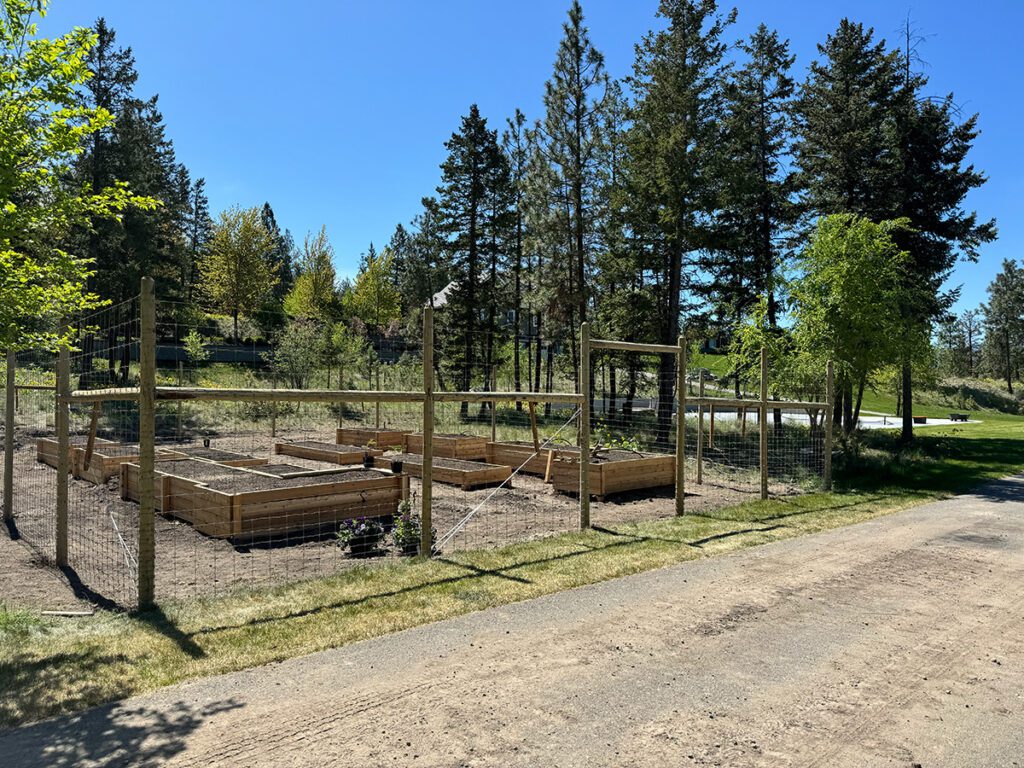
A deer fence around raised garden beds, using 8′ tall page wire.
By Lee Munsey, Owner at Boundary Fencing | September 2026
Wildlife is part of living in the Okanagan and Shuswap. For property owners, farmers, orchardists, and commercial operators, wildlife can also cause serious damage to gardens, crops, landscaping, infrastructure, and property.
Wildlife exclusion fencing is built on one principle: identify the animal you are trying to keep out, then build the fence for that animal. In practice, that means 8-foot page wire for deer on farms and orchards, electric strands for bears, and tight-grid welded wire for snakes.
No single fence design works for every animal. A fence designed to deter deer may not stop a bear. Height, mesh size, material, ground clearance, gates, terrain, and installation quality all matter.
Deer Fence Height: 8 Feet for Farms, About 6 Feet for Most Yards
Deer are the most common reason we’re asked about wildlife exclusion fencing in the Okanagan.
For agricultural, orchard, and commercial applications, 8 feet is generally the standard height for a deer fence. Deer are capable jumpers, and installing a shorter fence to save money can compromise the purpose of the entire system.
For residential properties, the situation can be different. Many municipal bylaws restrict fence heights to approximately 2 metres, or just over 6 feet, depending on where the fence sits on the property. In Vernon, for example, Zoning Bylaw 6000 allows 2.0 metres along side and rear lot lines and 1.2 metres in front yard setbacks.
A 6-foot deer fence will deter most deer, particularly if they aren’t highly motivated to get to the other side. But it shouldn’t be represented as completely deer-proof. We’ve seen deer jump fences of this height.
If you’re inside Vernon, Kelowna, Salmon Arm, or another municipality, check the local fence-height regulations as one of the first steps in planning the project.
How Much Does a Deer Fence Cost in the Okanagan?
As with any fence project, the cost per foot varies with the size of the project, access, terminal and corner points, and ground conditions. An 8-foot deer fence that runs 1,000 feet on flat ground with good equipment access will cost far less per foot than a 6’6″ deer fence in a backyard where we have to hand dig every hole and carry all the material in piece by piece.
The price ranges below assume average ground conditions and easy access. For a residential comparison, see our black chain link fence cost guide.
| Fence Length | Cost per Foot | Cost for Project |
|---|---|---|
| 1,000′ | $25/ft to $35/ft | $25,000 to $35,000 |
| 500′ | $35/ft to $45/ft | $17,500 to $22,500 |
| 250′ | $50/ft to $60/ft | $12,500 to $15,000 |
| 100′ | $60/ft to $65/ft | $6,000 to $6,500 |
What Does an 8-Foot Page Wire Deer Fence Look Like?
For a typical agricultural deer fence, one of the most cost-effective options is graduated page wire.
On an 8-foot system, we typically use 4- to 5-inch-diameter, 12-foot treated wood posts, with proper bracing at termination points including corners, ends, and gates. As with any agricultural fencing, the bracing holds the structure of the fence together. At 8 feet, building that bracing properly matters even more.
The fence should also follow the ground as closely as practical.
People naturally think about deer jumping over a fence, but deer will also try to crawl underneath flexible fencing. Keeping the mesh properly tensioned and close to grade helps prevent this.
Gates require a slightly different approach. A rigid framed gate can have some ground clearance without creating the same problem. For example, a 6-inch gap below a rigid gate isn’t generally enough for a deer to crawl underneath. That clearance also matters in the Okanagan and Shuswap, where snow and ice need to be considered if the gate has to operate through the winter.
Residential Deer Fencing Doesn’t Have to Look Agricultural
For large acreages and orchards, page wire fence usually makes sense because of the amount of fencing involved and its relatively low cost.
On a smaller residential property, chain link can be reasonably comparable in cost, and there are many more options when appearance is important.
Depending on the allowable fence height and the property, residential deer fencing could incorporate chain link, ornamental fencing, composite fencing, or other privacy fence systems. Our chain link vs. vinyl vs. composite comparison covers the trade-offs.
That means a homeowner doesn’t need to surround a landscaped backyard with agricultural page wire just because deer are the problem.
Why Cheap Plastic Deer Fencing Gets Expensive
One product we commonly see people try is lightweight plastic deer fencing.
It’s attractive mainly because it’s inexpensive and relatively easy to install. The problem is durability.
Flimsy plastic fencing generally doesn’t perform well for very long. Once it stretches, tears, sags, or gets damaged, it stops working as a barrier. We’ve had customers contact us after trying these products because they ultimately needed a more permanent solution.
For a small deer fence for a garden, a temporary product may be adequate depending on expectations. But if the objective is a long-term wildlife exclusion system, material quality and installation quality matter.
Snake Fence Options: Welded Wire or Specialized Exclusion Barriers
Wildlife fencing isn’t limited to large animals.
We’ve also installed snake exclusion fencing, including both tight-grid welded wire and specialized wildlife exclusion products.
One specialized system we’ve worked with, Animex, is a plastic barrier designed specifically for snake and amphibian exclusion. A short lower section is bent and buried, while the upper portion is bent outward to make it more difficult for critters to get past the barrier.
It works, but it’s also an expensive product.
For most residential or agricultural applications, a tight-grid welded wire fence is a much more economical solution. It can often be retrofitted to an existing fence, which can substantially reduce the cost of the project.
We installed the specialized snake-exclusion product because a highway project specifically required it, not because a residential property necessarily needs that level of specialized material.
Bear Fencing: Why Electric Is the Practical Deterrent
Bears present an entirely different challenge.
A standard page wire fence should not be relied on as a bear-exclusion system. If the objective is to keep bears out, an electric bear fence is the practical deterrent. WildSafeBC publishes minimum standards for bear-excluding electric fences.
We’ve incorporated strands of electric fencing into page wire systems where additional deterrence was required.
This is a good example of why wildlife exclusion fencing needs to be designed for the specific animal. Making a conventional fence taller or stronger doesn’t necessarily solve the problem.
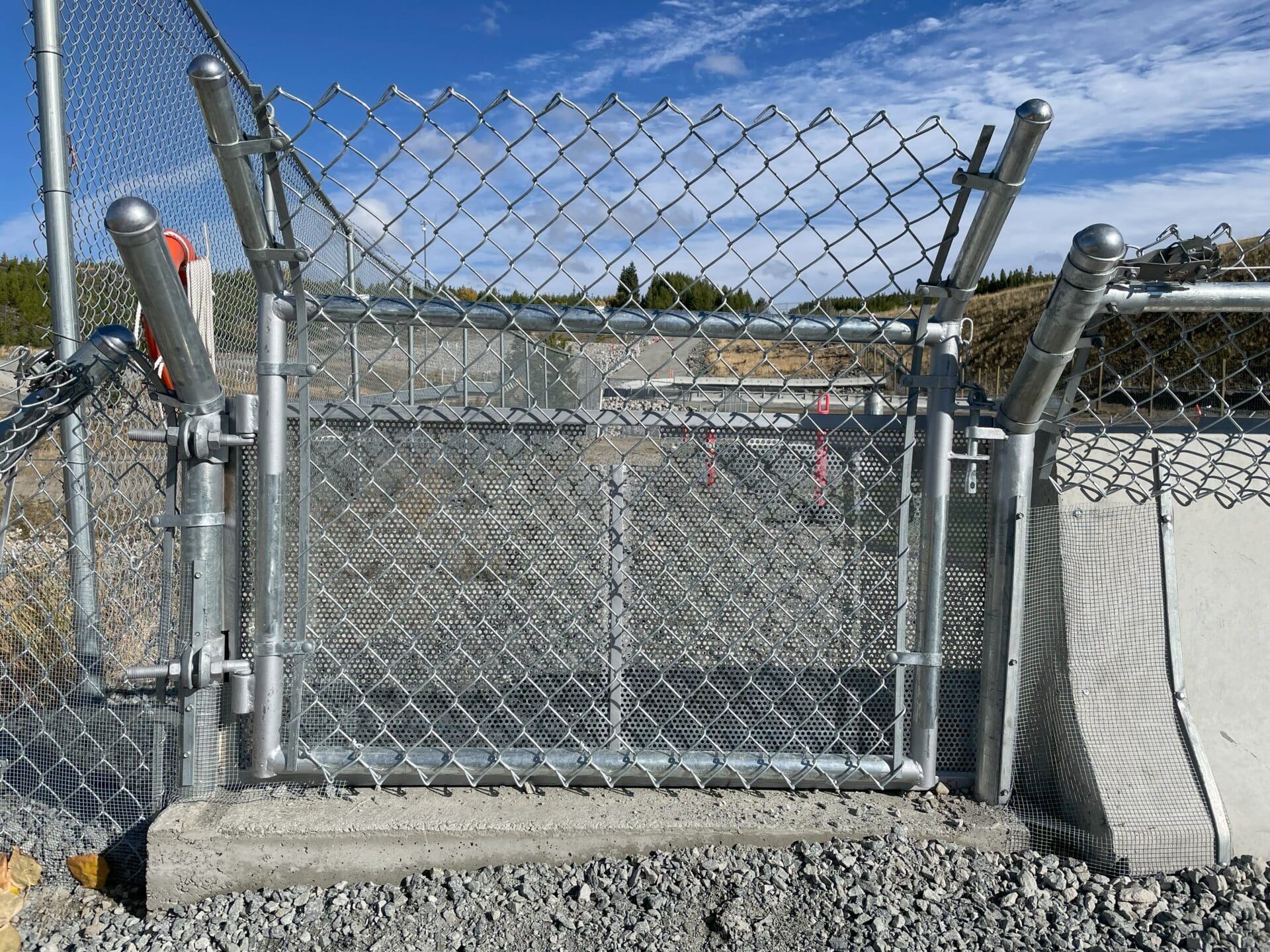
Muskrat and amphibian exclusion fencing around the settling ponds at Pennask Summit on the Okanagan Connector. A perforated steel panel on the gate and tight-grid mesh along the base keep small animals out, and the concrete sill closes the gap under the gate.
Muskrat and Amphibian Exclusion: The Pennask Summit Project
One of the more unusual wildlife exclusion projects we’ve completed was at Pennask Summit on the Okanagan Connector.
The area has settling ponds that muskrats need to be kept out of. We were contracted to install a dedicated muskrat exclusion fence around the ponds.
Later in the project, it was determined that additional animal exclusion was required, and we were contracted to install an additional tight-grid mesh designed to prevent amphibians from entering the ponds.
It’s a good illustration of how specialized wildlife fencing can become. The animal you’re dealing with determines everything from the opening size of the mesh to what happens where the fence meets the ground.
Installation Is Part of the Wildlife Exclusion System
Even the correct material won’t perform properly if the fence isn’t installed correctly. Mesh needs to be properly tensioned. The fence needs to follow the terrain closely enough to prevent animals from getting underneath it. Corners, ends, and gates need adequate bracing, and the posts need to provide enough support for the height and loading of the fence. A poorly supported fence that eventually leans, sags, or falls over is more than an ineffective wildlife barrier. It can also become a maintenance and safety problem. Wildlife exclusion fencing should be treated as a complete system rather than a roll of wire attached to posts.
Planning Wildlife Exclusion Fencing in Vernon, Kelowna, and the Okanagan
Even the correct material won’t perform properly if the fence isn’t installed correctly. Here’s how Boundary builds a fence, from foundation to finish.
Mesh needs to be properly tensioned. The fence needs to follow the terrain closely enough to prevent animals from getting underneath it. Corners, ends, and gates need adequate bracing, and the posts need to provide enough support for the height and loading of the fence.
A poorly supported fence that eventually leans, sags, or falls over is more than an ineffective wildlife barrier. It can also become a maintenance and safety problem.
Wildlife exclusion fencing should be treated as a complete system rather than a roll of wire attached to posts.
If you’re considering wildlife exclusion fencing in Vernon, Kelowna, Salmon Arm, or elsewhere in the Okanagan and Shuswap, a conversation is usually the best place to start. Request a site visit.